
“Making money is art and working is art and good business is the best art.” Andy Warhol
Licensing your art to a reputable company is a wonderful way to make your art available to the world. What I love about licensing:
- You’ll earn money off of one piece of art over and over again
- You can get your art on quality products without having to produce them yourself (leave the production and sales to the experts)
- It’s one more way to get your art and name out into the world
The difficult thing about licensing is that there is no solid road-map to follow. Sure, there are general rules, but it’s not easy getting the information on it.
Which leads me to this question that I received by e-mail today from a friend who has rapidly become a popular surf artist in Southern California:
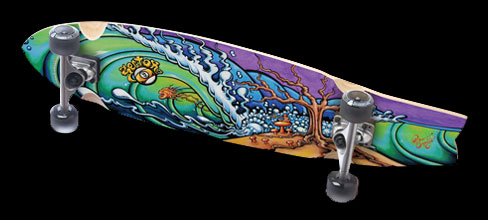
“I’m going to sign with a company to use my art on their skateboards but am only working on a royalty basis. What is a common way to go about doing this – percentage, etc.?”
I’ve handled about 200 licensing deals over the past ten years for my husband, Drew Brophy, and a few other artists, and not one of those deals were the same!
There are many different aspects to a license agreement, and I won’t be able to cover all of them here, but I’ll hit on the basic points.
First, I would ask this artist how many designs the company wants to use.
FLAT FEE BASIS:
If it’s not a complete line of skateboards, but only 3 or 4, then I would recommend not doing a royalty deal but rather a fee per design. I’d do this for 2 reasons:
1 – Unless it’s a toy company that’s going to sell 10,000 skateboards, the royalty won’t be worth it because the volume will be low. You’re better off getting paid the full amount up front, and:
2 – The accounting of royalty reports is a pain the butt for your client, and for small deals, it’s a waste of their time.
The flat fee per design can range from $300 to $3,000. What you can charge depends on your reputation, the popularity of your art, and what they are willing to pay. Our typical flat fee for Drew’s designs are $1,500 per design, when providing existing art to a small company that will produce a small number of units. For some of you reading this, $1,500 will sound like not enough. True, I agree! But, Drew likes to work with companies that make products that he likes, and many of them are small and can’t afford much more. Some of you will see $1,500 as being a high number. And maybe for many it is. That’s the interesting thing about this business – the numbers are all over the place and are subject to the perception of the people on both ends.
You have to figure out for yourself what to charge, and eventually you’ll come to a formula that makes sense for you and your clients.
If you are new to licensing and your art isn’t very well known, you might have to charge on the low end to build up your portfolio. But please, don’t do this for long, because then you’ll lower the bar for all artists. Be sure that once you’ve got a few successful deals under your belt, you start inching your prices up to where they should be.
ROYALTY ONLY BASIS: If the company wants to do a complete skateboard line with your designs, then a royalty deal could make sense. Be sure you get an advance of royalty up front.
We rarely go into a deal without a non-refundable advance of royalties paid up front.
A royalty advance is a dollar amount paid to the artist at signing, before creating and/or providing the artwork. This advance is deducted from future royalties that are to be paid to the artist.
WHY GET AN ADVANCE OF ROYALTY? Without an advance of royalty, the client has no incentive to make this work. They may drop it from the line, or they may go out of business, or a new person comes in and changes things, etc. It’s one tool we use to be sure that the client is serious about making it work.
The other reason is that we are not a bank. Meaning, we aren’t able to do the work up front without getting paid anything for 6-18 months.
Your advance is insurance that you’ll be paid something in the event anything goes wrong.
And believe me, things go wrong. Here are a few real “wrong things” that we’ve experienced with licensees over the last decade:
- A 50 year old toy company (one of the largest in the U.S.), went bankrupt one month after we gave them the artwork for a kid’s skateboard line (good thing they paid us $5,000 advance for all the work Drew did)
- A kid’s clothing co. had their Drew Brophy line ready to go, then a new partner came in and nixed it. The line never made it to retail, which means there were no royalties to be paid. (Good thing we were paid $5,000 also.)
- A license plate company owner, after we did a deal for Drew Brophy Plates, shut down his business to join the airforce! (We were only paid $1,200, but it was something.)
- A cell phone screensaver company never sold anything after we provided over 20 images and put hours into the contract, marketing information, etc. (we were paid nothing up front here so we ate this one).
There are so many things that can prevent your line from making it to retail. If it doesn’t make it to retail, there’s no royalties. And that means that you’ll be paid nothing for your efforts unless you’ve received an advance up front.
HOW MUCH SHOULD A ROYALTY ADVANCE BE? This depends on so many factors. Sorry, I know that’s frustrating! If you are Disney, you can require anywhere from $50,000 to $200,000 up front. But in the real world, for your average artist, it will have to be more realistic.
There are two ways that we’ll ask for advances, and it depends on the size of the deal, the company, etc.:
- FLAT FEE ADVANCE: We use $5,000 as our benchmark. However, if we are dealing with larger companies for big deals, we’ll go as high as $15,000. (We usually put a cap on the number of images provided for a flat fee, to ensure that the client won’t keep asking for an endless supply of new art season after season. Another insurance policy…..)
- PER DESIGN ADVANCE FEE: We’ve gone this route with a licensee that produces Drew’s beach products, because they use so many designs. They’ve used up to ten designs just for skim boards. Charging per design ensures that Drew isn’t providing a limitless number of designs.
EXCEPTIONS: There are exceptions to everything in licensing. In the case of a t-shirt licensee, Coastal Classics, we provide many new designs each season but don’t charge any advance because our royalty payments from them are high enough to satisfy. We’ve worked with them for four years, and they have a track record that we can count on.
ANOTHER EXCEPTION: Sometimes a company just won’t pay advances. It’s rare for us to move forward with these companies, for the reasons I’ve stated above, but I can name one instance that I made an exception and it’s worked out great. Skin-It.com doesn’t do advances with any of their licensors because they’ve been burned on a few, and we decided to do the deal with them anyway, because they are large enough to where they actually feature Drew’s art on national t.v. commercials. (One of the commercials was running during Christmas.)
(NOTE to the Licensing Experts out there on why I’ve omitted information on a Guarantee: I don’t typically work with guarantees – I prefer advances up front. It’s the business model that’s worked well for us.)
ROYALTY PERCENTAGE: Percentages are all over the board in licensing, too. They are based on the product being produced, the number of items projected to sell, the value of the artwork (popularity), etc.
There are books that you can refer to and find ranges to this. I refer to Licensing Art and Design: A Professional’s Guide to Licensing and Royalty Agreements
For skateboards, you can ask for anywhere from 6% to 10%. If it’s a large company that sells in major retail chains, you’d go with a lower percentage such as 4 or 5%, because your volume will be higher. If it’s a smaller core company that sells in skate shops, you’d go with a higher % because the volume will be lower.
Just to give you an example of how percentages are all over the board: For paper goods like posters or greeting cards, the range can be anywhere from 10% to 18%. For high volume (in the tens of thousands of units) shoe sales or boogie board sales, you would go as low as 3% – 4%.
OTHER POINTS TO WORK INTO YOUR CONTRACT OR AGREEMENT:
- State that Artist retains the copyrights to the artwork. (This is a no-brainer, but you’d be surprised at how many great brains don’t get this concept.)
- Contract start and end date. (We typically go for 2 years.) DO NOT allow an automatic renewal. For so many reasons I have to write another post on this topic.
- Samples: Ask for a number of samples (for skateboards, I’d ask for 2 or 3. For less expensive products, we’ll get a dozen or more.)
- Approval: Artist must approve, in writing, the final sample before going to production (this gives you control over your art)
- Signature: Artist’s signature must appear legibly on the product and copyright notice (i.e. (c) Artists Name) must appear legibly on all marketing and advertising materials. This is important for protecting your copyrights.
- Payments: Must be made MONTHLY or QUARTERLY – however you determine with the client.
- Royalty Reports: Must be issued Monthly or Quarterly (see above) regardless of whether there’s been sales or not. Reports must state retailers names and quantity sold per design. (This information will be greatly helpful to you when determining what your best selling images are, as well as which stores are carrying your products.)
I recommend getting more information on licensing agreements as you go along – this barely skims the surface.
Here are some of my related articles on this topic:
- THE MAKING OF A GOOD ART LICENSING AGREEMENT
- WORK SMARTER, NOT HARDER: LICENSING YOUR ART 101
- BRANDING ART – FROM SURFBOARDS TO GREETING CARDS
- THE ART OF THE DEAL MEMO
- OUR BIGGEST MISTAKE EVER – IN THE ART BUSINESS
My final parting words: Move forward, do your deal, get into licensing. The best way to learn about licensing is to just do the deals without hesitation.
Don’t be afraid of making a mistake, because you will. And that’s okay – you’ll learn from it.
Don’t be afraid of being ripped off: that can happen, and you’ll learn from it.
Good luck on this, and please, anyone, if you have any questions on anything that wasn’t clear in this post, let me know in the comments below!
Maria xxoo
Would you like your own licensing agreement template that you can use again and again? My new LICENSING AGREEMENT/CONTRACT TEMPLATE PACKAGE is now available. This package makes it easy for you! Complete with a template that you can change as needed, and instructions, this is the perfect short, simple agreement for artists not yet ready to hire an attorney. More details here: http://store.drewbrophy.com/
 PS: You can find more very helpful tips for art licensing deals in my eBook, co-written with artist Tara Reed, called How to Understand Art Licensing Contracts.
Click the link to find out more about it!




77 Responses
Makes complete sense Maria, excellent touching on the main questions I had. I have had one skateboard deal before that was based on a flat fee, but this new one is royalty only. I will use this info to better guide my contract negotiations with the company. Thanks!
Great article Maria. I’ve done some nice deals and it’s always nice having you to bounce things off of, whether by phone or thru your cyber-self here.
Great information! …Now I just have to get a licensing deal! I am pondering going to NYC for Surtex (textile convention) and the National Stationery Show. I know artists set up booths there. Have you gone? I would probably show my portfolio around. Do you walk various shows, portfolio in hand?
Hey Aileen,
I would recommend walking different licensing shows. There’s a small one here in Anaheim, CA called CHA on Jan. 24th and 25th. I haven’t done this one yet, but we’ll be there for a book signing for Drew at the Walter Foster booth.
I believe CHA has booth space for really cheap compared to Surtex and License. You might want to check it out, since you’re local.
Hey Maria,
I’m actually planning on attending the CHA supershow which is the public show before the trade one… I wasn’t sure how to get into the trade show without paying $150! I definitely want to scope out the scene before getting a booth. If I get into the trade show, I’ll definitely stop by Walter Foster. Love those books!
Thx!
Hey Maria, it was a real pleasure meting you and Drew yesterday at Sacred Craft. Also, thanks for the tips on licensing. It sounds like an excellent way to go.
Hi Maria, I have a question regarding trade shows. I’ve been very fortunate as an artist in the advertising business. However, my passion is surfing and would like to do work in that area. Would the upcoming Sacred Craft show in October be a good time and place to launch the brand?
Maria,
Great article again.
thanks
Olivier
Hi Maria,
This is extremely helpful and timely. Thanks for being so generous and sharing your knowledge. I appreciate it.
Wow, that was awesome, a great primer. Thank You. I will forward this to my mom, who needs it badly.
Really great article! Thank you for your honesty!
great article and information….thank you maria
Thanks for this Maria!! Just listed to you speaking with Tara Reed! Great help call! Appreciate your input. AND, that led me to your site here where I’m finding more great tips!!
Jeanne, thanks so much for commenting on my blog post! I’m glad you were on the line with Tara Reed and myself tonight. Thank you!
Hi,
I just discovered you site. Great information.. one question…could you recommend info on which skateboard companies would be interested in licensing art? are there certain brands I try contacting?
Lejarie, thanks for the comment. I’m glad you found my blog!
To answer your question – Which skateboard companies should you contact?
Research the different companies out there – see which ones are already selling art that your art will fit in with. And then send them to your website or email them samples of the artwork that you would like to license for their use.
Good luck!
Thanks
\((*0*)//
I am so interested in getting licensed regarding my art. My work would be great for stationery, fabrics, and clothing lines. Recently, I’ve designed images for cellphone and other electronic accessory, a skull line as well. Please consider me for such possibilities. Thank you, living professionally as an artist for over 25 years on Maui.
Thanks for the extremely useful info. I have another question. Are royalties usually calculated on the sale price to the client, or on the profit the manufacturing company is making on each unit? A company is offering me 5% of the profit on each unit, which is turning out to be 1% of the sale price they are getting from the client. This seems really low to me, and i have been reading up on net sales price/gross price etc. and am confused how i see what is fair and negotiate correspondingly. Thanks for your help.
Anika, thanks for your comment and your question. Royalties are figured on the gross sales receipts a co. receives. For example: They are selling dinnerware with your art on it. Royalties are payable at 6% – their total revenues received are $50,000 – you get paid 6% of $50,000.
It’s not a good idea to agree to a % of profits. Ask the company to pay you 5% of the revenues they’ve received. It’s not even worth your time to go into a deal where you’re paid 5% of the profit. I would be wary of that deal.
The word “Net Sales” is typically defined in a contract as “Licensee’s gross sales less only the sum of actual cash discounts, quantity discounts and freight discounts and actual returns for damaged or defective Licensed Articles.”
Net sales is basically gross sales (total revenues received from sales) minus returns and credits for defective items.
I hope that clears it up for you!
i wonder if they accept paintings as well. i mean i have lot’s of designs I have created on the mac, but i really want to push my twisted fable series. because they do well where I live, but now i want to license them in other facet of business, I’m thinking lunch boxes, puzzles etc..
Maria you’re input wold be most appreciated. I’ve only been doing this for less than a year, but getting an artist agent is tough…
Maria, thank you so much for all the super useful, informative and generous posts about art licensing!!! I got to know art licensing a few months ago and am really interested in trying it out! Thank you again for all the info you shared!!!!!!!
THANKS MARIA!
another great, informative article.
will you represent me at licensing shows????
pleeeeeeeeeeeease?!?!?!
talk soon,
tom
Thanks for the Info. Great information. Funny how many sites I’ve visited charge for information. You have a good heart to share all this information. I have a question. When licensing you mentioned that the “Artists retains the copyrights to the artwork”
QUESTION:
1. Do I need to obtain the copyright first before looking to be licensed?
2. What would be the fee for copyrighting.
3. Can I license without any proof of copyrights to my art?…
Hahah sorry, its actually more than one question.
Thanks for your sincere help,
Ceciah
Ceciah, these are great questions! Answers below:
1 – You do not have to file for copyrights before licensing your art. However, it’s wise to file your copyrights for images that you will be licensing, as you will be protecting not just yourself, but your licensees as well.
2 – Copyrighting is $35 if you do the online filing through http://www.copyright.gov website. You can file a group of images under one filing, as long as they were created in the same year and they were all either published (printed) or all unpublished.
3 – Yes, you can license your art without copyrighting. Licensees (the company that licenses from you) will not ask for proof. But they do ask that you are the legal copyright owner/creator of the work.
I hope this helps! Maria
Great advice for any royalty project not just skateboards. Ceciah has great questions on copyrighting, I’d love to hear your thoughts!
Adam, thanks for the comment. I answered Ceciah’s questions – see above. Let me know if you need any other info! Maria
Thanks Maria! I thought to license you had to have a copyright.
Thank you VERY MUCH Maria, your answers were clear and less confusing then other articles I have read. They go around the issue not getting to the point. I appreciate your time and awesome layout of the questions. 🙂 Thanks a Bunch. Ceciah
Hello Maria,
I just remembered another question that Ive been wanting to ask you. Is it best to find companies on my own to license my art or find an agency that will do the work? Ive had a real bad experience with an agency, for a totally different sort of product which they basically scammed me, but is licensing art with an agency, different from those scam artist who call themselves agencies for product development?
Sincerely,
Ceciah
It’s best to have an agent, IF that agent is a good one. The trick is finding a good agent that believes in you enough to put in the time. For every good agent out there, there’s a few dozen bad ones….
This is very useful information.Thanks a lot. I’ve been recently approached to do a licensing agreement for my t-shirt line in the asian market. They have offered 10% and I personally think it too low, any advice on what is fair?I would hate to say no without having the right information at hand. Thanks for any help in advance.
Cecil.
Cecil: Yes, to license your art, you MUST be the copyright owner of the art. You can’t license someone else’s art or your art if you have sold the copyrights to someone else.
This doesn’t mean that you have to FILE your copyrights – you are the owner the moment you create it (unless it’s a Work for Hire or for an Employer). But, I recommend that you file your copyrights so that you can get full protection under the law for your art.
Cecil,
So sorry, the last answer I gave to you was actually for someone else’s question…that’s why it didn’t make sense.
To answer your question – 10% is good, however, when dealing with an overseas company, I would be very careful to have a good advance up front (anywhere from $1,000 to $10,000 depending on different factors), to make sure they are the real deal, and make sure you get references and call those references. Business is done differently in China and Brazil and other countries – you have to be very careful.
Thank you very much Maria. This is quite helpful.
Cecil.
I have many idea’s and designs, so can I get these designs to u to sell them or represent me to your prospective clients.
kind regards
jp
Hi Maria,
Thanks for this great website! I emailed you at consulting@mariabrophy.com and the delivery failed. Is there another way I can contact you?
-Shane
My name is Felix Kilimakher, I draw science fiction toys, but I would like to turn them into
Lamps or toys. Would your company be interested in developing such toys?
My problem is that I have no capital or any way to get it out there, I could not afford to go to toy fairs with just my drawings. The drawings are time traveling chairs. I need a partner that’s in this toy industry.Please respond.
I would like to have my art on t-shirts help.
Felix-216-224-9424
fk3975@yahoo.com
=
Wow- what a great article! I am an artist and I am thinking of trying to get my work out there via licensing. Your article is very informative…and encouraging! THANK YOU!!
=
You talk about artwork and that is awesome info, and much appreciated. My question is about skateboard designs, the board itself. Do you have any ideas or info in that? Any would be greatly appreciated.
Maria…if you have the time you should create an ebook on licensing art to skateboard/surfboard industry with tips, resources and manufactures!! I would definitely purchase if it priced reasonably. Just an idea
Thanks for the post – this definitely helps!! I was just contacted by an agency working with a high-end hotel interested in my photography. They mentioned being interested in 150 prints and they would like to know my pricing and terms before moving forward. I am feeling stuck, because I have no idea what the typical price is for deals such as this! I don’t want to under-value my art, but I also don’t want to set a number so high that they choose another artist (this is such a great opportunity to get my name out there!) Any advice???
Becca, congratulations on getting this wonderful opportunity! I would work out a % of the sale (payable to you up front). You need to find out: who’s doing the printing? How many are being printed? What is the price per print that the hotel is paying? Then, ask them to send you a written offer. Make sure that you retain all copyrights and that the agreement is non-exclusive for this deal. If you need help putting the deal together, I offer consulting – go to http://www.MariaBrophy.com/Consulting 🙂
Hi, Maria
Great article! I have a question: I seem to run into companies who just want to buy your design and not mess with royalties. I know NOT to do this, though I did with two designs, selling them for a decent fee, but still, the point of my business is to multiply my time and talent, not just keep doing ‘dollar per hour’ work. Would you recommend pressing these companies for a licensing deal, or just walking away with no deal? This was a greeting card company. I’d love to work with them again, but can’t possibly just sell designs to them outright. Thanks in advance!
I should clarify: they bought one piece out of my portfolio, with its rights, and commissioned another, with its rights included (I was desperate at the time).
Christine, thanks for the comments!
To answer your question – For smaller sales, a flat licensing fee, payable up front, is preferable. Royalties can complicate things for small companies that aren’t set up for the accounting that’s required with licensing reports. In the future, with smaller deals/companies/low volume sales products, charge a “One Time Flat Fee for 2 years usage for greeting cards” or whatever the product is. Get the money paid up front, and keep the copyrights. That way you can take that same art and license it for other products, too.
Maria, this is the information my brothers and i have been searching for. Excellent article and informational links. My brothers and I are starting our own skateboard company but also are interested in licensing to other companies. So this fills me in very well, however I have another deal with a clothing line that is just starting out, what do would be a fair way to handle the deal so that everybody wins but if they expand dramaticly in a short time, my brothers and I don’t get underpaid. Thanks so much!
Jamil, thanks for the comment. To answer your question – a fair deal will be one where you get some pay up front and royalties on sales. That way, if the line sells well, everyone benefits. Hope that’s helpful!
Hello Maria, I was wondering if its possible to use the designs I’m making for a clothing company and say, a skateboarding company? But I believe since I own the rights to my artwork then that means I can license it to whoever wants to use it is that correct?
Sherif, thanks for the question. Yes, in licensing, it’s done this way – you use the same art for many products with many different people. For example, my husband’s SUNRISE artwork is currently on over 30 different products with about 8 different companies. The companies and products are all non-competing with each other.
Maria, in the case of a limited run (3 or 4 designs), with a small reach where you are going to charge a flat fee per design is this also limited to 2-3 years? Meaning, the flat fee is for a 2-3 year period and after that it can be renewed? Thanks from one stubborn Slovak to another!
Victoria, great question! In all business arrangements, the deal is whatever you decide. So, to be specific, yes, when you charge a flat fee you could keep the term short (1-2 years). When it’s time to renew, if they are happy with the sales, you will be able to re-negotiate for a higher flat-fee with your next term.
This was a great overview Maria; every word you write counts. As a writer, I have been down these roads as well. It is comforting to know that many types of artists/creative people have similar concerns. Thanks again!
What are the royalty rates for a consumable pet toy and\or shelter?
Brilliant overview, good to finally find some posts by someone who knows what they are talking about. Have sent this post to a few artists who have found it very useful, especially dealing with the big corporates. In NZ, the country is so small (4 million) I often recommend against royalty, and instead go for the one fee approach.
Excellent article! You answered several questions. My niece has been asked to create some designs for a respectable children’s clothing line. This is new and exciting for her. I don’t want her to get “burned” her first time out. Thank you for the great advice.
They have asked her to give a suggested purchase price for the design up front and offered 8% royalty fees to be paid quarterly.
Being her first, what would you suggest the upfront fee be?
Paula, great question, thanks for writing!
There should be an advance up front, which goes against future royalties.
For a children’s clothing line, the advance could range from $1,000 – $6,000 depending on how much work is involved up front. The advance is always payable up front, before creating the work.
The most important thing, even more important then the amount of the advance, is making sure that an advance is paid up front. That ensures that the licensee is serious about putting the line out there. Many times, after having an artist do a lot of work, the line never makes it to retail. The advance ensures that you are paid at least for some of your time, should that happen.
If you would like professional help with the deal, and the licensing agreement, please set up a consulting call with me. I can help! See my consulting page for details: https://mariabrophy.com/consulting
just want to know if you could charge me some money to just find the Licensing manager at several brands….mostly all in California..thank you and appreciate response and congrats! on your job, is very instructive.
Salomon, It’s fairly easy to find out the names of the licensing managers – just call the company and ask for the name of the person who handles licensing! Or, do a Google search of the name of the company and “licensing Manager” or “Art Director” – this should help you get the right person.
Where To Get cheap Saints jerseys free shipping
DYING to license my designs to anyone everyone..please reply add me as friend on facebook to view.. see what you think..supporting alz stroke disabled mom and myself and need more work coming in.. im a custom tile fabric wallcovering designer with over 6000!! come view them all in albums here at https://www.facebook.com/NASCUSTOMLIFE
Thanks so much for writing this! I’m familiar with your husband’s work- he KILLS it! Dealing with a very small skeetboardin company right now with a great mission so it’s good to see a nice guideline for the “if everything was to go the right way” way of doing this licensing thing. Thanks again!
Hi Maria,
I’ve been designing a few top sheets for a little ski company in Canada they’ve just asked me to do another design for them next year. The previous designs I did for them had the words “Artwork by Emily Beaudoin” on them, and they’re asking that I give them $500 off the payment for this newest design in exchange for putting my name on this newest design. In their eyes it’s free marketing for me, and that should have a price tag on it this time.
Is this a reasonable request on their part? My first instinct was so keep my name on the design, but after looking at other ski designs, most do not have the artists name included. If I did want to keep my name on the skis, is paying them for that a reasonable thing to do?
Thanks so much!
Hi Emily,
Thanks for the question. We have been licensing Drew’s art for many, many years, for products including hard goods (like skis). We always REQUIRE that Drew’s name / signature/logo is printed on the art. It is how licensing is typically done. There should be no discount for them adding your name – just because other artists are not savvy to how these things work (artists that allow their names to be left off), that shouldn’t affect how you run your art business. I would tell them “In licensing, it is standard practice to print the artist’s name on the product. I don’t give a discount for that. I hope you understand.”
Thank you for the advice Maria, I’ll stand my ground!
Hi Maria, Thanks a lot for the post. I’m an artist in Brazil. I am willing to take my arts to American and Canadian companies. Do you do consulting or the “bridge” for these companies? I can send you my drawings for you to review.
Hello so I have a question my nephew does great drawings how do you send them without them using them without your permission, Thanks Lisa
I started a small skateboarding company and ask a friend if he can help with art work. He agree to help out. He never ask for money until he back out and doesn’t want to help any more what can happen?
Bagus isi bacaannya, Terima Kasih