
“The most important requirements for major success are: first being in the right place at the right time, and second, doing something about it.” Ray Croc
Every now and again I’ll be accused of writing too often about the negative things that artists have to contend with.
I tend to write mostly about problem clients, bad contracts and deals gone sour.
My defense is that I don’t think artists want to read only the frilly, happy things that go on. There’s much more to learn from our problems and mistakes.
But today, I’m going to share a positive story about a licensing deal gone well.
This morning there was a violent rain pour outside my office when the postal carrier peeked her head in the door and announced the delivery of a couple wet boxes.
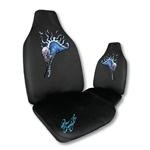
I was expecting this shipment. It came from Australia and it contained samples of the car sunshades and seat covers that bear Drew’s surf art.
My stomach had nervous butterflies prior to opening the box, because sometimes when we get samples from a licensee, we are disappointed. The product may not be the quality that was promised, or the artwork is missing an important element, or they got the colors all wrong.

Not this time.
Today I remembered what makes my job so thrilling. Drew and I tore open the box and were immediately elated! The car seat covers and the sunshades were better than we thought – top quality, great reproduction of the artwork and beautiful colors.
And I thought about how fortunate we were that we could make this happen with a company located all the way on the other side of the world.
You could say it started in New Zealand last February. Drew and I took a month long vacation and drove around the North Island. When we take these big trips, I’ll find opportunities to spread a little art around the globe while we’re on the road and to make good business contacts in the process. So I lined up a few painting demonstrations at surf shops on the North Island.
I also remembered that two years ago, at the New York Licensing Show, I had met a licensing agent from New Zealand. I sent him an e-mail and asked that we meet in Auckland to discuss representing Drew Brophy art on that side of the globe.
Over bacon and eggs at Auckland’s Sky Tower we met with Mark Paul of Global Licensing Ltd and agreed to have him handle Drew’s licensing in New Zealand and Australia. Not even two months later we had a deal with Sperling, and only ten months later the products are in stores.
Now, this story of the Sperling license sounds like everything flowed just the way it should, but I want to point out that there are so many things that could have caused a snag in this deal; things that an outsider can’t see.
In order for this one little deal to come together so nicely, we had to take action on a number of things. And here I’ve laid it all out for you:
First, we were exhibiting at the License Show in New York a couple years ago when we met this agent. Had we not been there, he wouldn’t have known we existed.
Second, we made the effort to meet with him during our vacation in New Zealand. He said yes, and when we met we had a frank discussion about having him represent Drew, then we moved forward onto the agent-agreement phase.
Third, I had our attorney help with the legal agreement with the agent. Not too complicated, but without her help, I might have foiled it.
Fourth, our new agent presented the opportunity to enter into an agreement with Sperling. Now, this is where it really could have run into a few snags. You see, dealing with companies in another country can be worrisome if you aren’t experienced with that. Customs, accents, copyright laws, VAT taxes (I still don’t get that exactly), all those things that are foreign that we have to deal with!
We worried about the distribution channels, because we wanted to be careful that the product doesn’t go into a Wal-Mart type store. Since we don’t live there, we aren’t familiar with the stores that are right or wrong for Drew’s art.
And this is where many artists stop the discussions. They get confused over the complications and then they stop communicating, and eventually, the project dies.
I think that taking the risks despite the complications is what is necessary to move forward. It’s really just trusting that it will all work out.
Fifth, we provided the artwork and made sure that Drew’s art, logo and signature were all properly represented not just on the product itself, but on the packaging.
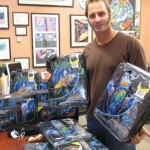
The end result is a licensing deal that we are thrilled with. The products are something that Drew is proud of. He loves that his skull-waves are being printed on car seat covers and driven around the country of Australia.
Check back with me in about three months and I’ll report on the royalties. Because that is the final test of a good licensing deal – the amount of money that you make!
Maria xxoo








9 Responses
Great article, Maria. Very inspiring. I really identify with the need to overcome complications – which can make you want to give up – and having the faith that if you stick with something, it’ll probably work out.
Cool post Maria. I’m really appreciating the info you give on the business side of art. It’s much needed! Cool products.
The UK would love some Drew Brophy products too! 😉 You guys are very inspirational to me atm, Thankyou!
Your energy is so vibing with how Im feeling right now..
Great read…going the extra mile with deals is always smart in the long run.
You should license a Maria action figure next 🙂
Thanks, Jay! You do always go the extra mile – you are a shining example of what artists can do to generate collectors and interest. The caveat is, it’s an effort, and work. But you seem to make it look like fun!
thanks for the knowledge!this is really cool for you to share.i.m signing up!!!
thanks again
ronnie jackson
Good one María. I’m glad it’s all going well. I wouldn’t worry too much about the Walmart type stores. The worst Walmarts are in the US 😉
Thanks for the comment, Danny. I agree, the Wal-Marts in the U.S. are the worst. The rest of the world hasn’t commercialized like the U.S. has. If you put your art on tee-shirts and they’re sold in the Wal Mart here, you’re career is on it’s last legs!
Ouch! That last sentence… “If you put your art on tee-shirts and they’re sold in the Wal Mart here, you’re career is on it’s last legs!” Just reading it makes me cringe.